Uncategorized
Replica Tier Guide 2026: Difference Between Budget, AAA, and 1:1 UA Sneakers
05
Jun
Jun
That “1:1” label on your favorite marketplace is probably a lie designed to drain your wallet for a pair that’ll crumble after three months. 👟 Understanding the actual difference between replica tiers is the only way to move like a pro in 2026. You’ve seen the jargon. AAA, UA, and God Version. It’s a mess of marketing hype that leaves most buyers terrified of getting called out in public. You’re likely tired of wasting cash on low-tier batches that fall apart before the hype even dies down.
We get it. You want the aesthetic of a Travis Scott x Air Jordan 1 Low or a Louis Vuitton Trainer without the soul-crushing resale prices. This guide is your cheat code to mastering the market. You’ll learn exactly how to identify top-tier quality so you never overpay for mid-grade kicks again. We’re diving deep into the manufacturing precision of LJR and M batches. We’ll even look at why authentic leather hits 1.4 g/cm² while budget reps usually weigh in much lighter. Get ready to spot high-tier flaws and secure that 1:1 confidence. 🔥
Key Takeaways
- Master the difference between replica tiers to distinguish between low-grade flea market pairs and retail-identical masterpieces.
- Learn to spot red flags instantly by identifying “boxy” toe boxes and sniffing out chemical-heavy synthetic materials used in budget batches.
- Discover why industry insiders ignore generic labels and focus on specific factory versions like GX for the ultimate Jordan 4 silhouette.
- Stop wasting cash on “AAA” mid-grades that use cheap plastics and start investing in UA quality that passes the on-foot test every time.
- See how a rigorous inspection process filters out the trash so your rotation only features the highest-tier sneakers available in 2026.
Breaking Down the Hype: What Are Replica Tiers Anyway?
Tiers aren’t just flashy labels sellers slap on a box to justify a price hike. They’re a roadmap of the entire manufacturing process. In the global market for counterfeit consumer goods, tiers represent the full spectrum of quality. You’ve got everything from “flea market” trash that smells like a chemical plant to “retail identical” heat that even experts struggle to debunk. Back in 2020, you were lucky if a rep didn’t have a backwards logo. By 2026, the standards have shifted. Top-tier factories now use 3D scanning and CNC cutting as standard practice to mirror the exact silhouette of a Nike Dunk Low or an Adidas Yeezy Boost 350 V2.
The industry uses these levels to categorize manufacturing precision and material costs. A high-tier pair uses the same weight tumbled leather or primeknit as the retail version. A low-tier pair is usually just plastic spray-painted to look like the real thing. Understanding the difference between replica tiers is the only way to keep your rotation fresh without getting called out in public. It’s about knowing what’s under the hood of your kicks.
Terminology varies depending on where you spend your time. On Reddit, people talk about specific “batches.” On Discord, it’s all about the latest QC photos. Online shops might use terms like “Master Grade” or “AAA.” Don’t let the platform change your focus. A replica tier is a manufacturing standard rather than a fixed brand.
The Problem with Marketing Jargon
Sellers love to play mind games with new buyers. They use terms like “Real” or “Original” to trick you into thinking they’ve got leftover stock from an official factory. That’s cap. The truth about “Unauthorized Authentic” (UA) is that it’s a quality standard, not a secret back-door deal. Stop looking at the flashy names and start looking at the factory output. Whether it’s a Dior B23 or a Travis Scott x Air Jordan 1 Low, the quality is in the stitch count and the material weight, not the buzzwords.
Why Tier Knowledge Saves You Money
Knowing the difference between replica tiers keeps your bank account healthy. The “budget trap” is a massive drain on your wallet. You buy a 50 dollar pair that looks okay, but it falls apart after three wears because the sole glue is basically school-grade paste. Sometimes, a mid-tier rep is “good enough” for a simple silhouette like a Nike Air Force 1 ’07. But for complex builds like a Balenciaga Triple S, you need that top-tier precision. Invest in quality once, and you won’t have to buy the same shoe three times because the first two crumbled.
The Replica Hierarchy: From Budget Fakes to 1:1 Masterpieces
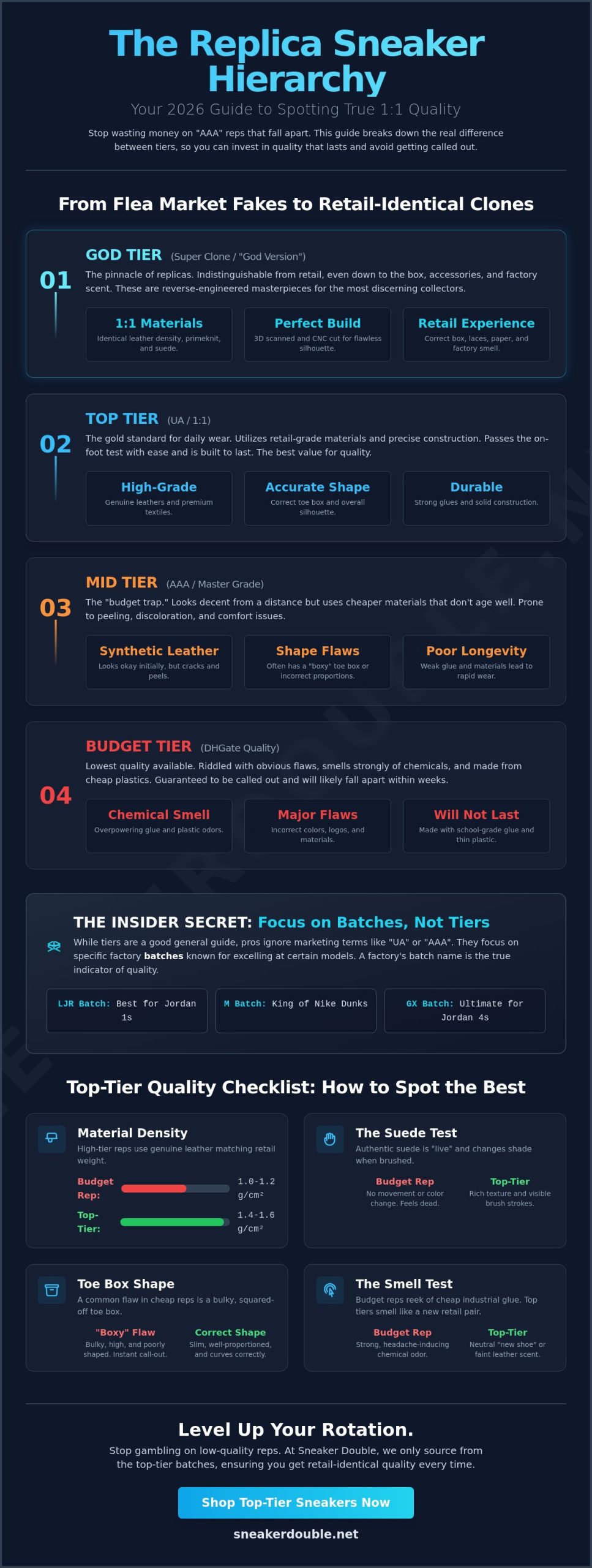
The replica market isn’t a monolith; it’s a ladder. At the bottom, you have budget tiers, often called “DHGate quality.” These are entry-level kicks for casual wearers who just want the look without the investment. They use cheap glues and thin materials that won’t survive a rainy day. Moving up, you hit Mid Tiers like AAA or Master Grade. These offer better shapes but still rely on synthetic leathers that peel over time. The real heat starts at Top Tiers (UA/1:1). This is the gold standard, utilizing retail-grade materials and precision machinery. By 2026, we’ve seen the rise of Super Clones. These are elite. Even the box, the extra laces, and the factory scent match the retail experience perfectly. 🔥
Understanding the difference between replica tiers is about knowing where your money goes. High-tier factories don’t just copy the look; they reverse-engineer the entire build. They source the same raw components as the big brands. This hierarchy ensures there is a pair for every budget, but the smart money always moves toward the top to avoid the “instant call-out” or a shoe that crumbles in six months.
Material Differences: Leather, Suede, and Mesh
Materials are the biggest giveaway. High-tier reps use genuine full-grain leather that weighs between 1.4-1.6 g/cm², matching the specs you’d find at retail. Budget versions often use a plastic coating that clocks in at a lighter 1.0-1.2 g/cm². A New York Times investigation previously highlighted how factories in Putian evolved their sourcing to mimic these exact textures. Take the “Suede Test” on a Travis Scott rep. If the hair doesn’t move when you brush it, you’re looking at a budget pair. For a Nike Air Jordan 1 Retro High OG, high-tier batches offer a stitching density that matches the original factory run, ensuring the silhouette stays sharp. 👟
Construction and Comfort: What You Can’t See
The difference between replica tiers is often hidden inside the sole. Budget pairs use hollow rubber where a pressurized “Air” unit should be. It feels like walking on bricks. Top-tier reps actually integrate pressurized gas units or BASF-sourced foam. This provides the same orthopedic support as the real deal. You’ll feel this immediately in a high-quality Adidas Yeezy Boost 350 V2. The sole longevity is night and day. While a cheap rep might bottom out in months, a 1:1 pair stays responsive for years. If you’re ready to level up your rotation, check out the curated selection at Sneaker Double for guaranteed quality.
Tiers vs. Batches: The Insider Secret to Finding the Best Quality
Stop looking at generic quality labels and start looking at the source. A “batch” is simply a specific factory’s version of a shoe. While the difference between replica tiers tells you the general quality level, the batch name tells you exactly which factory produced the heat. Think of tiers as the league and batches as the individual teams. Some teams just play better than others. In 2026, the elite factories have moved beyond basic copying. They use high-end CNC machines and 3D scans of retail pairs to ensure their molds are perfect. This is why a batch like GX dominates the Jordan 4 market. They’ve mastered the specific “wing” shape and heel tab flick that other factories miss.
Even the highest-tier replicas have “Batch Flaws.” These are tiny, consistent errors that occur across an entire production run. It might be a slightly off shade of thread or a tongue that’s 2mm too short. The community tracks these flaws religiously. Top factories stay on top by releasing “updated” versions of their batches to fix these issues. If a batch gets a reputation for a “corner stitch flaw,” you can bet the 2.0 version will have it corrected within weeks. This constant evolution is what separates the elite factories from the low-tier shops that never change their molds.
The Big Names: LJR, PK God, and OG Batches
LJR is widely considered the king of Nike Air Jordan 1 Retro High OG consistency. They’ve nailed the hourglass shape and the leather texture. If you want a pair that looks retail on the shelf and on the foot, LJR is usually the move. For more complex collaborations, PK God is the go-to. They specialize in the intricate details of a Nike Dunk Low, often sourcing the exact materials used in limited releases. These factories don’t just build shoes; they refine them through multiple “batches” until the community gives the green light.
When to Choose a Specific Batch over a General Tier
Finding the “Best in Slot” is the ultimate goal for any serious collector. For high-profile drops like the Travis Scott x Air Jordan 1 Low, you shouldn’t settle for a general “UA” label. You need the specific batch known for getting the suede movement and the reverse swoosh placement right. However, if you’re just looking for a “beater” shoe to wear to the gym, a mid-tier batch might be a smarter play. It saves you cash while still providing the look you want. Just watch out for “Batch Switching.” Dishonest sellers might promise you a top-tier LJR pair but ship a budget batch instead. Always verify your source to ensure the difference between replica tiers actually works in your favor.
The Quality Checklist: How to Identify Top-Tier Reps Like a Pro
You’ve got the batch names. You know the hierarchy. Now you need to trust your own eyes. Identifying the difference between replica tiers is a skill that separates the tourists from the residents in this culture. Don’t just look; analyze. Start with the silhouette. Budget pairs are notorious for a “boxy” toe box that looks more like a construction boot than a sleek sneaker. A high-tier 1:1 pair will have that aerodynamic slope that flows into the midfoot perfectly. 👟
- Material Feel: Get close. Authentic leather has a faint, natural scent. If it smells like a chemical spill or a tire shop, it’s a low-tier batch using synthetic coatings.
- Stitching Precision: Look for consistent spacing. High-tier reps avoid “widow’s peaks,” which are those tiny triangular leather bits left over from poor manual cutting.
- The Hourglass Shape: This is essential for identifying high-quality Jordans from the back. The heel should swell at the top and bottom while pinching in the middle. Budget pairs look like a straight brick.
- Weight and Balance: Top-tier reps match the exact gram weight of retail. High-tier Jordan 1 leather should hit around 1.4 to 1.6 g/cm², while cheap reps feel suspiciously light at 1.0 to 1.2 g/cm².
Spotting the “Dead Giveaways” in Low Tiers
The “Swoosh” is the first place budget factories mess up. It’s often too thin, too hooked, or placed so high it looks like it’s trying to escape the shoe. Color accuracy is the next hurdle. Budget batches often miss the mark on specific “University Blue” or “Mocha” shades, coming out too vibrant or too dull. Check the tongue tags too. If the font kerning looks cramped or the “R” trademark is a blurry blob, you’re holding a mid-tier pair at best. 🔍
Advanced QC (Quality Control) Techniques
Stop comparing your kicks to professional studio photos. Go to the “Used” sections on resale apps to see how real pairs age and crease. This gives you a realistic benchmark for how materials should behave. Also, don’t trip over the “Corner Stitch Flaw.” Even retail pairs sometimes have stitching that touches the swoosh; it’s not an automatic sign of a fake. Ultimately, 1:1 quality means the shoe passes a visual inspection from 2 feet away while it is on your feet. If you want to skip the guesswork and secure guaranteed heat, grab your next pair from Sneaker Double and move with total confidence.
Level Up Your Rotation: Why Sneaker Double Only Rocks the Top Tier
You’ve done the homework. You know the difference between replica tiers. Now it’s time to secure the bag. Most sellers are happy to flip mid-tier batches for top-tier prices. We aren’t most sellers. At Sneaker Double, we focus exclusively on 1:1 and UA standards. This is where the elite best high quality replica sneakers live. We don’t just source shoes; we curate them. Every pair in our catalog is a result of deep industry connections and a refusal to settle for “good enough.” 👟
Our Sneaker Double Inspection Process is ruthless. We reject mid-tier batches so you don’t have to deal with the disappointment of a boxy toe box or chemical smells. While Reddit lists “trusted sellers,” those middlemen often skip the deep-dive quality checks we perform daily. We maintain global support teams in the US and China to ensure tier consistency across every single shipment. This isn’t just about selling a shoe; it’s about providing a luxury experience without the soul-crushing secondary market tax. Double your wardrobe value. Keep your style ahead of the curve. 📈
Beyond Sneakers: Luxury Accessory Tiers
Luxury isn’t just about what’s on your feet. The tier system applies to LV White Shoes Reps and designer leather goods too. High-end leather goods require even more manufacturing precision than sneakers. We’re talking about hand-stitched details and specific full-grain leathers that budget factories can’t even dream of replicating. We curate over 400 styles to maintain a “Top Tier Only” catalog. If a designer bag or a pair of luxury loafers doesn’t pass the 2-foot test, it doesn’t make the cut. We specialize in the items that are no longer available through standard retail channels. 💎
Join the Insider Culture
Stop settling for budget trash that falls apart in a month. Start wearing the best. Move with the confidence of knowing your kicks pass the “eye test” everywhere, from the club to the office. You’ve mastered the difference between replica tiers, so don’t let a low-quality batch ruin your fit. We provide the smart, stylish alternative for the fashion-conscious consumer who refuses to play the resale game. Secure your rotation today and feel the difference of true craftsmanship. 🔥
Browse the latest 1:1 drops at Sneaker Double now!
Step Into the Future of Your Rotation
You’ve officially leveled up from the “flea market” struggle to true insider status. Understanding the difference between replica tiers is your ultimate defense against overpaying for mid-grade kicks that fall apart after three wears. You now know why retail-grade leather weight and silhouette precision matter more than any flashy marketing label. Stop gambling on sellers who hide behind “AAA” jargon and start demanding the factory-level accuracy your fit deserves. 👟
We’ve built the infrastructure to make your choice simple. Sneaker Double bridges the gap with a rigorous multi-point quality inspection that rejects the trash before it ever ships. With over 400 curated styles and dedicated support teams based in the US and China, we guarantee consistency across every single drop. It’s about more than just shoes; it’s about the confidence of knowing your rotation is untouchable. 🔥
Cop the highest-tier 1:1 replicas at Sneaker Double!
Your next masterpiece is waiting. Grab it today, double your wardrobe value, and own the streets with 1:1 confidence.
Frequently Asked Questions
What does UA stand for in sneakers?
UA stands for “Unauthorized Authentic.” It is a quality standard used in the replica community to describe pairs that use the same materials, patterns, and technical specs as the retail versions. While the name implies they were made in the original factory without a contract, it is actually a benchmark for high-level manufacturing precision. In 2026, UA remains a top-tier choice for those who want that retail-identical look and feel. 👟
Is there a difference between 1:1 and UA replicas?
There is very little functional difference between 1:1 and UA replicas in the current market. Both terms are used interchangeably by sellers to describe the elite tier of sneakers that mirror the original product’s silhouette and tech. The actual difference between replica tiers usually comes down to the specific factory batch rather than these marketing labels. Always prioritize the batch reputation over the generic label to ensure you are getting the best heat.
Are AAA grade sneakers good quality?
AAA grade sneakers are considered mid-tier quality. They offer a significant step up from budget “flea market” pairs by correcting major shape flaws, but they still rely on cheaper synthetic leathers and standard glues. They are fine for casual beaters, but they won’t pass a close inspection from a seasoned enthusiast. If you want the luxury experience and long-term durability, you’ll need to step up to UA or Super Clone levels. 📈
How can I tell if my replicas are high tier?
You can identify high-tier reps by analyzing the silhouette and material response. High-quality pairs feature a distinct hourglass shape from the back and a sleek, non-boxy toe box. Perform the “Suede Test” on pairs like the Travis Scott x Air Jordan 1 Low; the hair should move when brushed. Understanding the difference between replica tiers means looking for these specific details that budget factories consistently miss in their production runs. 🔍
Why are some replica batches more expensive than others?
Price discrepancies between batches are driven by raw material costs and manufacturing tech. Top-tier factories invest in expensive CNC machines and 3D scanners to ensure 1:1 accuracy. They also source premium components like real full-grain leather and pressurized Air units. A budget batch uses plastic coatings and hollow soles, which are cheaper to produce but lead to a shoe that crumbles much faster than a high-end masterpiece.
What is the best batch for Jordan 1 replicas in 2026?
The LJR Batch remains the undisputed king for Jordan 1 replicas in 2026. This factory has mastered the specific heel shape and leather texture required for the Nike Air Jordan 1 Retro High OG. While other factories might offer decent mid-tier alternatives, LJR provides the most consistent retail-identical experience. If you are hunting for the absolute best, LJR is the batch name you need to remember for your next pickup. 🔥
Do top-tier replicas come with original-style packaging?
Yes, top-tier replicas almost always include original-style packaging. This means you get the correct box, color-matched tissue paper, and all the extra laces or accessories that come with the retail release. Super Clone tiers in 2026 even match the font kerning on the box label and the specific factory scent. It is a complete luxury experience from the moment you unbox your new pair and add it to your rotation.
Can replica sneakers be used for actual sports or basketball?
You can use top-tier replicas for sports, but avoid budget tiers at all costs. High-tier reps for performance models utilize functional cushioning tech like Zoom or pressurized Air. They provide the support needed for casual play. However, budget pairs use hollow rubber soles that offer zero impact protection and can lead to injury. If you are hitting the court, only rock the top tier to ensure your feet stay protected. 🏀