Uncategorized
Do Replica Sneakers Have Real Leather? The 2026 Insider Truth About Rep Materials
09
Jun
Jun
That legendary “new shoe smell” shouldn’t remind you of an industrial chemical fire. When you’re hunting for a fresh pair of grails, the burning question is always the same: do replica sneakers have real leather or are you just paying for high-grade plastic? You’ve likely felt the sting of a budget batch that started peeling before the second wear. It’s a common fear in the community. Nobody wants to rock kicks that feel like stiff cardboard or smell like a tire shop.
We get it. You want the aesthetic of a Louis Vuitton Trainer or a Travis Scott Jordan 1 without the soul-crushing resale prices, but you won’t compromise on the touch. This guide is your 2026 insider pass to the material truth. We’ll show you exactly how high-tier replicas source genuine hides from the same tanneries used for retail pairs to ensure that 1:1 premium feel you crave.
Stop guessing and start stepping with confidence. We are breaking down the specific differences between UA, 1:1, and budget materials so you can spot quality from a mile away. You’re about to learn how to identify top-tier leather and where to find the reps that actually double your wardrobe value without ever sacrificing the luxury experience.
Key Takeaways
- High-tier UA batches source genuine cowhide and pigskin from the same global regions as major athletic brands to ensure 1:1 material accuracy.
- Master the “Press Test” and edge analysis to instantly distinguish between premium animal hides and the low-grade synthetic plastics found in budget tiers.
- Discover the definitive answer to “do replica sneakers have real leather” and why the specific quality batch is the most critical factor for your rotation.
- Learn why high-quality leather reps require the same maintenance as retail pairs to prevent peeling and ensure long-term durability.
- Level up your collection by understanding “Correct Grain” leather and how it transforms the premium feel of iconic styles like the Jordan 1 and LV Trainer.
Do Replica Sneakers Use Real Leather? The Short Answer
The short answer is a definitive yes. But there’s a massive catch: it depends entirely on the batch you cop. If you’re hunting for that 1:1 feel, you need to understand that the rep game is tiered. High-quality replicas don’t just look the part; they use genuine animal hides, including premium cowhide and pigskin, to mirror the retail experience. When people ask do replica sneakers have real leather, they’re usually looking for that buttery touch found on a Louis Vuitton Trainer or the rugged durability of a Nike Air Force 1 ’07. You won’t find that at the bottom of the price barrel.
Top-tier factories know the community is sharp. They’ve realized that to survive in 2026, they must source materials that match the original specs. Retail-grade leather is the only way to achieve the correct silhouette and weight. In the broader market of counterfeit consumer goods, sneakers have become the gold standard for material accuracy. If the factory cuts corners with cheap plastic, the shape collapses, the smell is off, and the “flex” is ruined instantly.
The Material Spectrum: From Plastic to Premium
Budget tiers are where most horror stories begin. These low-end reps often substitute genuine leather with synthetic PU (polyurethane). They feel stiff, they don’t breathe, and they carry a heavy chemical odor that screams “fake” from a mile away. It’s the reason your feet sweat and the shoes look “dead” after three wears. Mid-tier replicas offer a slight upgrade, often using a blend of genuine leather with heavy synthetic overlays to keep costs down while improving the look.
The real magic happens at the UA (Unauthorized Authentic) and 1:1 levels. These batches are a different beast entirely. Factories at this level invest in top-grain leather and authentic suede. Whether it’s the soft nubuck on a Travis Scott x Air Jordan 1 Low or the tumbled leather on a Retro High OG, these materials are selected to age and wear exactly like the pairs you’d find at a boutique. It’s about that premium hype without the resale tax.
Why Factories Invest in Real Leather
Why do these factories spend the extra cash on real hides? It’s simple: the “Crease Test.” Real leather has a natural grain that creases softly over time. Synthetic plastic doesn’t crease; it cracks. One solid day of walking in a budget pair will leave permanent, ugly white lines across the toe box. Genuine leather maintains its structural integrity, holding the sneaker’s iconic silhouette for months of heavy rotation. Modern rep enthusiasts demand 1:1 material matching, and factories have stepped up to meet that energy. They know that if the leather isn’t right, the whole shoe is wrong.
The Anatomy of Quality: Materials Used in UA Sneakers
UA factories aren’t playing around in 2026. They’re sourcing hides from the same leather-producing regions that supply the big athletic giants. This isn’t just about looking like the original. It’s about feeling like it too. While mass-market seizures often highlight substandard counterfeit products made of cardboard and glue, UA batches represent the elite side of the game. They use genuine materials to ensure the weight and flex are identical to what you see on the shelves.
So, do replica sneakers have real leather that actually lasts? Absolutely. High-tier leather is chosen for its “Correct Grain,” which is the specific texture and density required to mimic iconic silhouettes. If the grain is too tight or too loose, the shoe looks off under a blacklight or even just in direct sun. Durability on these 1:1 pairs often matches or even exceeds retail standards, especially as some major brands move toward “synthetic leather” to cut costs. You’re getting the real deal without the inflated price tag.
Tumbled Leather, Suede, and Nubuck
Getting the texture right is where the masters separate themselves from the amateurs. For Nike Dunk Low models, factories focus on tumbled leather with a soft, pebbled finish that yields to your touch. It should feel supple, not like a plastic toy. If you’re wondering do replica sneakers have real leather when it comes to high-gloss finishes, remember that patent leather is a treated material even on retail. However, UA versions use high-grade resins to avoid the cracking common in cheap reps.
Suede and nubuck require even more finesse. On high-end Travis Scott x Air Jordan 1 Low pairs, the “movement” test is the ultimate tell. Real suede has a nap that shifts color as you run your finger across it. If it’s “dead” and doesn’t move, it’s a budget batch. The factory smell is another giveaway. Premium leather batches smell like a high-end tannery, while synthetic batches reek of toxic industrial glue.
Tannery Standards in 2026
Color accuracy is the final boss in the rep world. Modern replica manufacturing uses advanced tanning processes to ensure the leather matches the exact Pantone of the retail version. We’ve seen factories reject entire hides because the shade was half a point off. This commitment to consistency is verified through rigorous Quality Inspection (QC) before any pair hits your door. It’s about maintaining that hype. If you want to ensure your rotation is built on these premium foundations, checking our latest arrivals is the best way to secure that 1:1 material quality.
Real Leather vs. Synthetic: How to Spot the Difference
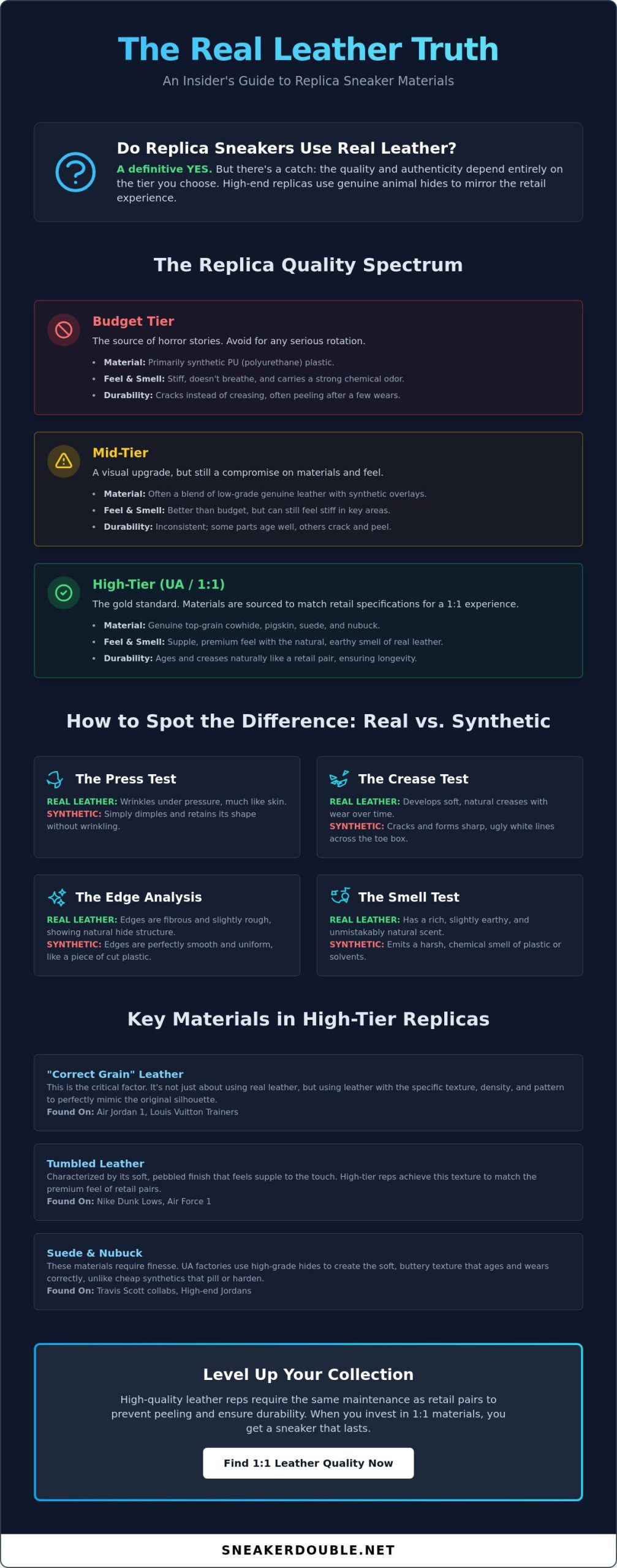
Stop burning your shoes. We’ve all seen those viral clips of people holding lighters to their kicks to “prove” they’re real. It’s a rookie move that just ruins your drip. If you’re still asking do replica sneakers have real leather, you need non-destructive ways to verify the quality. The most reliable method is the “Press Test.” Take your thumb and press firmly into the side panel or toe box. Real leather will create small, radiating wrinkles around the pressure point, mimicking the way skin moves. Synthetic “pleather” usually stays smooth or behaves like a rigid sheet of plastic. It’s a fundamental lesson in how leather quality is judged across the entire footwear industry.
Next, hit the edges. Look closely at the raw cuts of the leather panels near the stitching. On high-tier UA reps, you’ll see a slightly fibrous, “fuzzy” texture on the cross-section. This is the natural hide showing through. Budget batches often have a perfectly smooth, rubbery edge or a visible fabric backing that screams synthetic. Then there’s the scent. Genuine leather has an organic, earthy aroma that’s unmistakable. If your box opens and smells like a fresh coat of house paint or industrial solvent, you’re dealing with low-grade chemicals and heavy factory glues. Finally, feel the weight. Real leather is dense. A 1:1 pair should feel substantial and balanced in your hand, not like a hollow, lightweight toy.
The Water Absorption Test
This is the ultimate secret for the skeptics. Genuine leather is naturally porous. If you place a single tiny drop of water on an inconspicuous area of the shoe, real leather will slowly absorb it after a minute or two, leaving a temporary dark spot. On synthetic materials, the water will simply bead up and roll off like it’s on a rain jacket. Keep in mind that some high-end reps use Durable Water Repellent (DWR) coatings to protect the material, so this isn’t always 100% foolproof, but it’s a killer way to spot cheap plastic masquerading as a premium cop. 💧
Visual Cues: Pores and Grain
Grab your phone and use the macro lens for a close-up. You’re looking for pores. Real animal skin has an irregular, unique pore structure that never perfectly repeats. Machine-stamped synthetic leather often reveals a “repetitive” pattern if you look closely enough. It looks too perfect; too manufactured. You should also check the “nap” on the back of the panels if you can see them near the eyelets. Real leather has that characteristic suede-like underside, while fakes often show a mesh or woven fabric layer. This is how you ensure your next acquisition is built on authentic vibes, not cheap shortcuts. 👟🔥
Caring for Your Leather Reps to Ensure Longevity
You’ve secured the bag. Your rotation is looking elite. But here is the reality: if you’re rocking high-tier kicks, you can’t treat them like drugstore beaters. Because we’ve already answered the question do replica sneakers have real leather with a solid yes for UA tiers, you have to treat them like the luxury assets they are. Genuine hides require genuine maintenance. A pair of UA sneakers using top-grain leather needs the same love as a $1,000 retail pair to prevent drying, cracking, and fading.
Start with the right chemistry. Avoid harsh household detergents that strip natural oils from the hide. Use specialized sneaker cleaners that are pH-balanced. When you’re done cleaning, conditioning is your best friend. Leather is essentially skin; it needs moisture to stay supple. Applying a light leather conditioner every few months keeps the material soft and prevents the “stiff” feeling that leads to premature cracking in high-flex areas like the toe box. Store your pairs in a cool, dry place away from direct sunlight to preserve that fresh leather scent and prevent color oxidation. Ready to build a collection worth protecting? Shop our premium leather lineup now and start your legacy.
Cleaning Suede and Nubuck Reps
Suede and nubuck are the divas of the sneaker world. If you’re rocking the Travis Scott x Air Jordan 1 Low, you need a dedicated brush kit. A soft hog hair brush is perfect for light dust, while a crepe brush helps reset the “nap” and restore that signature movement we discussed earlier. If you catch a water stain, don’t panic. Use a suede eraser and light, circular motions. Never use a hairdryer or heater to dry your leather sneakers. High heat is a death sentence for genuine hides, causing them to shrink, warp, and lose their buttery texture forever. Let them air dry naturally.
Preventing Crease Damage
Gravity and motion are the enemies of a 1:1 silhouette. Use cedar shoe trees to maintain the internal structure of your Nike Air Jordan 1 Retro High OG when they aren’t on your feet. They absorb moisture and keep the toe box crisp. If you’ve already developed deep creases, try the “Ironing Method.” Place a damp microfiber cloth over the crease and lightly run a hot iron over it for a few seconds. The steam relaxes the fibers, allowing the leather to reshape. High-quality materials recover from this process beautifully, whereas budget synthetics would simply melt under the heat. Real leather earns its keep.
Double Your Style: Why Sneaker Double Prioritizes Premium Materials
We’ve broken down the science. We’ve shown you the tests. Now, it’s time to talk about the source. At Sneaker Double, we don’t just sell shoes; we curate a lifestyle built on material authenticity. When you ask do replica sneakers have real leather, we don’t just say “yes.” We prove it with every pair that leaves our warehouse. Our obsession with quality led us to seek out only the best high quality replica sneakers available in 2026. We’ve seen the “budget” garbage, and we’ve rejected it. You deserve kicks that feel as premium as they look. It’s about that 1:1 energy from the toe box to the heel tab.
Our rigorous Quality Control (QC) process is the backbone of our operation. We inspect the grain, the scent, and the flex of the hides before you ever see a tracking number. Whether you’re copping a fresh Nike Air Jordan 1 Retro High OG or a designer silhouette, we ensure the hides are retail-grade. No shortcuts. No “pleather” surprises. We ship globally with secure, double-boxed packaging to ensure your investment arrives in pristine condition. Your rotation deserves the best foundations.
The Sneaker Double Difference
We’ve spent years building direct relationships with top-tier factories in China. These aren’t standard workshops; they’re master craftsmen who understand the “Unauthorized Authentic” standard. They use the same high-end tanneries that supply the secondary market’s most expensive grails. Our curated collection features over 400 styles, each vetted for material excellence and structural accuracy. We’ve done the heavy lifting so you can focus on your fit. When we talk about do replica sneakers have real leather, we’re talking about the exact same grading you’d find at a boutique. 🏆
Ready to Upgrade Your Rotation?
Stop settling for plastic “budget” pairs that fall apart after a week. Don’t let your rotation suffer from chemical smells and cardboard textures. You shouldn’t have to choose between your bank account and your style. It’s time to experience the buttery feel of premium leather without the soul-crushing resale tax. Double your wardrobe value and step up to the UA standard. Browse our latest 1:1 arrivals and cop your pair today! 🚀🔥
Lock In Your Premium Rotation
The game has changed for 2026. You no longer have to settle for stiff plastic or toxic chemical smells when hunting for your next pair of grails. We’ve proven that the answer to do replica sneakers have real leather is a definitive yes; as long as you’re copping from the top-tier batches. By understanding the difference between UA quality and budget substitutes, you ensure your collection maintains its shape, scent, and buttery feel for years to come. Real leather is the only way to achieve that 1:1 vibe.
Stop gambling with your style and start investing in kicks that actually last. Every pair we offer is rigorously inspected for 1:1 material accuracy to guarantee you get exactly what you pay for. With worldwide shipping, real-time tracking, and dedicated support teams in both the US and China, your experience is our priority. It’s time to double your wardrobe value and step up to the premium standard you deserve. Score 1:1 Quality Kicks at Sneaker Double Now!
Frequently Asked Questions
Do all replica sneakers use real leather?
No; definitely not all of them. Only high-tier UA and Master batches use genuine animal hides like cowhide or pigskin to achieve 1:1 accuracy. Budget-tier reps usually rely on synthetic PU (polyurethane) to keep prices at the floor. If you’re paying bottom-dollar; expect plastic. Always verify the tier before you cop to ensure you’re getting the quality you expect. 👟
How can I tell if my Jordan reps are made of real leather?
Perform the “Press Test” on the side panel or toe box. Firmly press your thumb into the material; real leather will create radiating wrinkles around the pressure point while synthetic stays smooth or rigid. You should also check the raw edges of the panels. Look for a fibrous; fuzzy texture instead of a rubbery or fabric-backed finish. These are the hallmarks of a premium hide.
Why do some new replica shoes smell like chemicals?
That heavy chemical reek usually comes from industrial-strength glues or low-grade synthetic plastics used in budget factories. These facilities prioritize speed and cost over material curing. When people ask do replica sneakers have real leather; the scent is a major giveaway. High-quality reps using genuine leather typically have an organic; earthy aroma. If your box smells like a fresh coat of house paint; you’re likely dealing with a budget batch. 👃
Will replica leather shoes last as long as authentic ones?
High-tier leather reps can absolutely match the lifespan of retail pairs. Because UA batches use genuine top-grain hides; they age and crease naturally rather than cracking like plastic. With proper maintenance; including cleaning and conditioning; these kicks will survive your heavy rotation for months or years. Budget synthetics will fail much faster because they lack the structural integrity of real animal skin.
Do replica Yeezys use the same materials as Adidas?
Top-tier Yeezy reps use the same Primeknit patterns and BASF Boost technology found in official releases. While Adidas has moved toward sustainable synthetics; high-end rep factories still prioritize the original material feel to maintain the hype. This ensures the same comfort and stretch as the retail version. Always check the “Boost” texture on the outsole to verify you aren’t getting a cheap foam substitute. ☁️
What is UA leather vs. Budget leather?
UA (Unauthorized Authentic) leather is genuine animal hide sourced to match retail specifications exactly. It’s supple; breathable; and durable. Budget leather is almost always PU plastic or a thin leather scrap coated in a heavy plastic layer to mimic grain. When asking do replica sneakers have real leather; the answer is UA for real hides and Budget for cheap synthetics. The difference in feel is night and day.
Can I use regular shoe polish on replica sneakers?
You can use regular polish on genuine leather reps just like you would on retail pairs. High-quality hides react well to conditioning and shining. However; avoid using heavy waxes or polishes on synthetic budget pairs. Plastic doesn’t absorb polish; so it will just leave a greasy; streaky mess that ruins the look. Stick to a simple damp cloth for those synthetic batches.
Is it worth paying more for 1:1 leather quality?
It is absolutely worth the extra investment for 1:1 leather quality if you care about your rotation. High-tier materials don’t just look better; they feel better on your feet and last significantly longer than cheap alternatives. You avoid the “instant call-out” of plastic creases and that toxic chemical smell. If you want a shoe that actually doubles your wardrobe value; go for the premium hide every time. 🔥