Uncategorized
Can You Tell the Difference Between Real and Replica Shoes? The 2026 Truth
26
May
May
In 2026, the “call-out” is officially dead. You’re probably tired of staring at a pair of Travis Scott x Air Jordan 1 Lows on a resale site, wondering if that four-figure price tag is actually worth it just for the box. The fear of social embarrassment is real, and the inconsistency of random online sellers makes every purchase feel like a gamble. You want the heat without the house-payment prices, but the big question remains: can you tell the difference between real and replica shoes when the quality is this high? 🔥
We get it. You shouldn’t have to choose between your bank account and your rotation. The truth is that high-tier 1:1 replicas have reached a point of technical parity where even the experts are sweating. Discover why the gap between retail and top-tier batches has vanished and how to spot 1:1 quality like a seasoned pro. We’re breaking down the shift in manufacturing that makes UA kicks indistinguishable from what drops on the apps. Get ready to build a world-class collection of Louis Vuitton Trainers and Off-White Dunks with total confidence. 👟✨
Key Takeaways
- Understand why “fake” is an outdated term and how 1:1 UA quality now matches the technical standards of retail releases.
- Learn the professional QC steps to evaluate materials and silhouettes so you can answer the question: can you tell the difference between real and replica shoes in 2026?
- Debunk the myth of the “call-out” by seeing how high-tier craftsmanship from top factories fools even the most seasoned resellers.
- Master the insider touch test to identify premium Italian leathers and high-density foam midsoles used in elite batches.
- Discover the Sneaker Double advantage, where hand-picked selections ensure you only rock the top 60% of 1:1 production.
Can You Actually Tell the Difference Between Real and Replica Shoes in 2026?
The sneaker game just hit a massive turning point. For years, the gatekeepers tried to scare you with stories of “budget fakes” that fall apart after one wear. Fast forward to 2026, and that narrative is officially dead. While the global counterfeit market continues to expand, the top tier of that market has evolved into a high-tech powerhouse. We aren’t talking about cheap knockoffs anymore. We’re talking about precision-engineered footwear that challenges the very definition of “authentic.” 👟
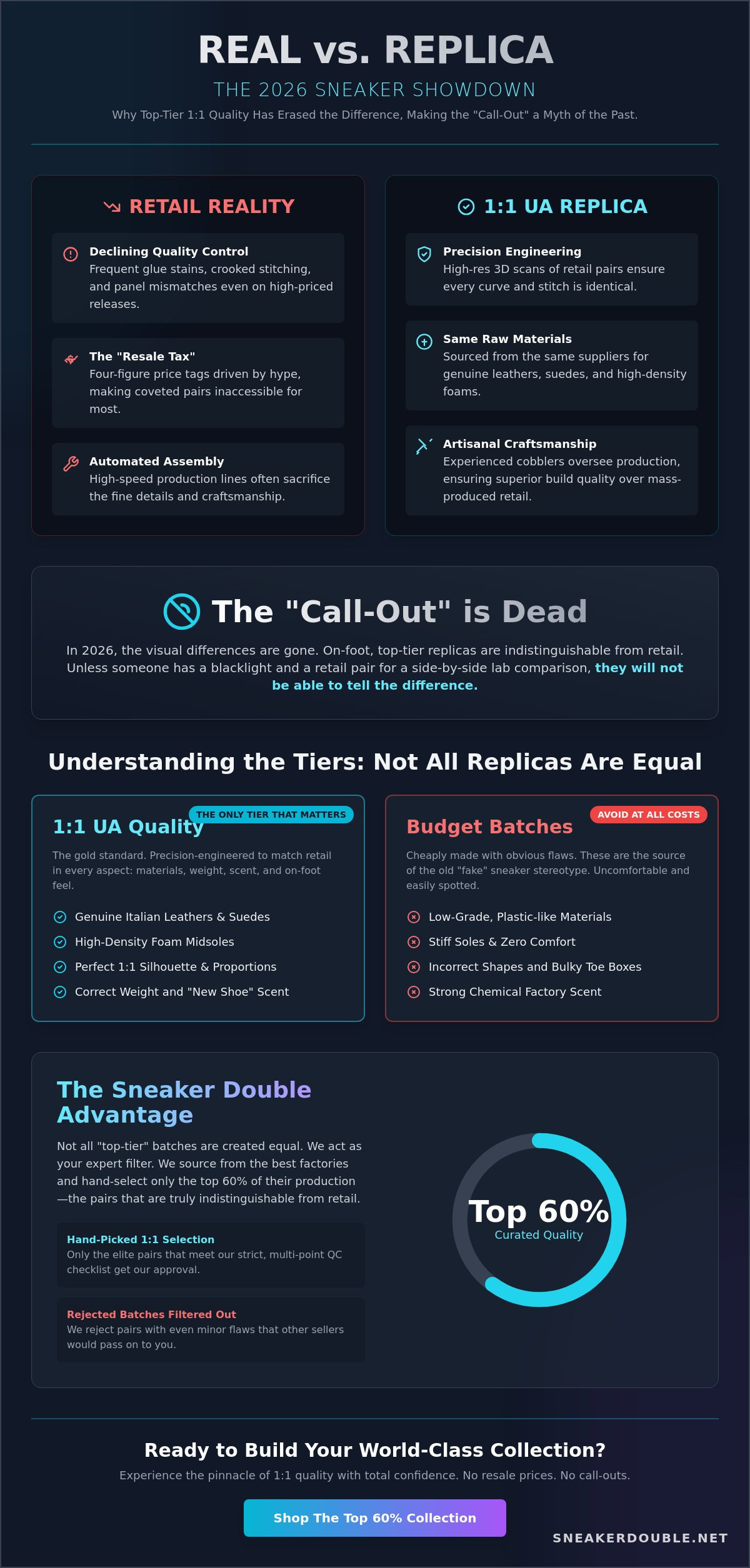
Retail giants are struggling. Quality control at major brands has plummeted, leaving fans with glue stains, crooked stitching, and mismatched panels on $200 releases. Meanwhile, high-end replica factories have stepped up, treating every Travis Scott x Air Jordan 1 Low like a masterpiece. This “Retail Tax” is becoming harder to justify when the alternative offers better craftsmanship. So, can you tell the difference between real and replica shoes in this new era? For most people, the answer is a hard “no.” The community is waking up and embracing a new mantra: wear what you love, not what the resale market dictates. ⚡
The Death of the ‘Call-Out’
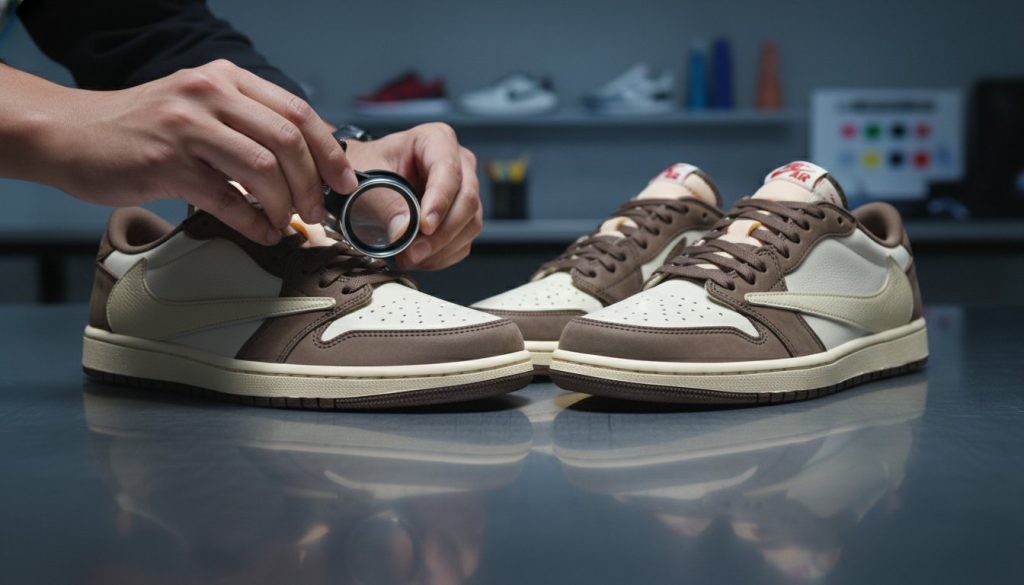
The era of being “called out” in the streets is over. In 2026, even the self-proclaimed “Legit Checkers” are taking Ls. Top-tier batches are now manufactured using high-resolution 3D scans of retail pairs, ensuring every curve and stitch is identical. On-foot, it’s impossible to spot a difference. Unless someone is following you with a magnifying glass and a blacklight, they’ve got zero chance. The visual flaws that used to plague replicas have been wiped out by superior tech. If you’re rocking 1:1 heat, you’re rocking with total peace of mind. 🔥
UA vs. Retail: Breaking Down the Terminology
Terminology matters if you want to level up your rotation. “Unauthorized Authentic” (UA) represents the gold standard. These aren’t the $30 flea market specials that look like cake. UA pairs are built in the same industrial zones as retail kicks, using the exact same blueprints. When you look for the best high quality replica sneakers, you’re looking for 1:1 parity in weight, scent, and texture. 💎
- Budget Batches: Low-grade materials, incorrect shapes, and zero comfort. Avoid these.
- 1:1 UA Quality: Genuine leather, high-density foam, and perfect proportions. This is the only tier that matters.
The price difference between a mid-tier rep and a 1:1 masterpiece is small, but the jump in quality is massive. Don’t settle for “close enough” when you can have perfection. 🚀
Inside the Factory: Why 1:1 Kicks Mirror Retail Standards
Forget the old myths about dark basements and amateur setups. In 2026, the factories producing high-tier replicas operate like tech hubs. They’ve invested millions into the same machinery used by major sportswear giants. When you ask, can you tell the difference between real and replica shoes, you have to realize the playing field has leveled. These facilities utilize industrial-grade 3D scanners to map every millimeter of a retail pair. They don’t just guess the shape; they clone it. 🧬
The human element is just as critical. While retail brands move toward fully automated, high-speed assembly lines that often miss the details, top-tier replica factories still rely on experienced cobblers. These artisans oversee the fine-tuning of the silhouette. They ensure the tension in the stitching is just right. This focus on craftsmanship is why modern UA pairs often feel more substantial than their retail counterparts. The Counterfeit Problem for big brands isn’t just about volume anymore; it’s about the fact that the “alternatives” are matching their quality head-on. 👟
Sourcing the Same Raw Materials
The “smell test” is officially a relic of the past. High-end 1:1 batches no longer use cheap chemicals that give off that toxic plastic scent. Instead, you get the rich aroma of genuine Italian leather and premium suede. Top-tier factories often secure their raw materials from the exact same tanneries and chemical suppliers that provide leathers and foams to official Nike and Adidas production lines. Whether it’s the “bounce” of a high-density foam midsole or the texture of Primeknit, the tactile experience is identical. If you want to feel that premium quality yourself, check out our latest 1:1 drops. 💎
Precision Stitching and Pattern Alignment
Consistency is where the best replicas actually win. Have you seen the “B-grade” quality coming off retail shelves lately? Crooked swooshes and frayed edges are everywhere. In contrast, 1:1 factories use CNC (Computer Numerical Control) cutting machines. These ensure every Nike Dunk Low pattern is cut to the exact millimeter of the original blueprint. The “Toe Box” and “Hourglass” myths were debunked years ago. With modern tech, the silhouette is perfect from every angle. You get the aesthetic you crave without the retail QC headaches. 🔥
Because these factories operate on smaller scales than global retail giants, they can afford to take more time on each pair. This leads to a level of detail that makes the question of can you tell the difference between real and replica shoes almost irrelevant. The materials are there. The tech is there. The heat is definitely there. 🚀
The Myth of Visual Detection: Why You Won’t Get Called Out
Stop sweating the small stuff. The internet is full of self-proclaimed “pros” who claim they can spot a rep from across the street. Most of them are capping. In the real world, no one is dropping to their knees with a magnifying glass to inspect the depth of your heel embossing. So, can you tell the difference between real and replica shoes when they’re actually on your feet? The answer is a definitive no. Visual detection is a myth fueled by outdated information and gatekeeping. 🧢
The truth is that the resale market’s recent failures have been the replica market’s biggest win. Major authentication platforms have been caught passing high-tier reps as retail multiple times in 2026. This “Expert Fallacy” proves that even the people paid to know the difference are struggling. When you source from a top-tier UA sneakers online shop, you’re getting a product that has already fooled the supposed gatekeepers. Rocking a pair of Travis Scott x Air Jordan 1 Lows with confidence is 90% of the game. If you act like they’re retail, everyone else will too. ⚡
The 3-Foot Rule
Most visual “tells” disappear the moment you stand up. This is the 3-foot rule. At a standing height, even a slight variation in the “Wings” logo placement or a minor stitch count difference is invisible to the human eye. In fact, many 1:1 UA batches now have more consistent logo placement than official retail pairs, which have been plagued by mass-production errors. Whether it’s the silhouette of a Yeezy Boost 350 V2 or the shape of a Nike Dunk Low, the on-foot profile is flawless. 🔥
UV Lights and Box Tags: The Final Frontier
Factories have officially cracked the code on the “hidden” details. In 2026, top-tier 1:1 replicas feature the correct invisible ink patterns that only show up under a UV light. They’ve even mastered the RFID chips and box tag fonts that used to be the final giveaway. Don’t get distracted by “StockX tags” or fake “Authenticity Certificates” because those are just props. The real value is in the shoe itself. 💎
The “call-out” is a ghost story used to keep people paying insane resale prices. When the technical details are this precise, can you tell the difference between real and replica shoes without a lab test? Not a chance. Your rotation deserves the heat, and your wallet deserves the break. It’s time to stop worrying and start wearing. 🚀
The 2026 QC Checklist: How to Spot Top-Tier Quality Yourself
You don’t need to be a professional authenticator to recognize elite craftsmanship. While the general public still wonders, can you tell the difference between real and replica shoes, you’re going to use a systematic approach to prove the quality of your rotation. High-tier UA pairs aren’t just about looking good; they’re about meeting specific technical benchmarks. If you want to ensure you’re rocking 1:1 heat, follow this five-step Quality Control (QC) framework. 🕵️♂️
- Step 1: The Material Touch Test. Run your hands over the leather or suede. Top-tier batches use genuine materials that have a natural resilience and texture. If it feels like cheap plastic or thin cardboard, it’s a budget batch, not a 1:1.
- Step 2: Proportions and Silhouette. View the shoe from a 360-degree angle. Thanks to 3D scanning, the “hourglass” shape on the heel and the slope of the toe box should be indistinguishable from retail.
- Step 3: Logo and Branding. Check the font weight and spacing. On a high-quality Travis Scott x Air Jordan 1 Low, the “Cactus Jack” embroidery should be dense and sharp, not frayed or thin.
- Step 4: The Internal Build. Pull out the insole. Look for tight, consistent stitching on the strobel board. Size tags in 2026 should have perfect font alignment and no bleeding ink.
- Step 5: The Smell and Weight. Real 1:1 pairs smell like premium leather, not industrial glue. They also match the retail weight to the gram because the midsole density is identical.
Ready to skip the stress and secure a pair that hits every mark? Grab 1:1 heat that passes every test right here. 🚀
Essential Tools for Your Home QC
Lighting is your best friend. Always inspect your kicks under natural sunlight or a bright white LED to check for color accuracy. Use high-resolution retail photos from official archives for a side-by-side comparison. For example, checking the Adidas Yeezy Boost 350 V2 “Boost” texture under direct light reveals the precise, pebble-like consistency that defines a 1:1 UA pair. 💎
Common ‘Tells’ That No Longer Exist
Forget the outdated advice from 2020. The “too shiny” leather myth is gone; modern factories use the exact same matte finishes as retail. Even the “back tab height” issues have been solved by automated cutting machines. Factories finally perfected the precise 3D placement and debossing depth of the “Wings” logo on 2026 Jordan 1 batches, eliminating the last remaining visual gap. When the tech is this advanced, can you tell the difference between real and replica shoes anymore? Only if you’re looking at the receipt. 🔥
Why Sneaker Double is the Ultimate Insider Source for 1:1 Quality
You’ve seen the technical shift. You know the “call-out” is a relic of the past. Now, the only thing standing between you and a god-tier rotation is finding a source you can actually trust. While most sellers just drop-ship whatever the factory hands them, we operate differently. At Sneaker Double, we’re your boots on the ground. We hand-pick every batch from the top 1:1 facilities in the world. When you ask, can you tell the difference between real and replica shoes, our goal is to make sure the answer is a hard “no” every single time. 😤
Trust is earned through transparency. That’s why we established our “Double Quality” promise. We reject approximately 40% of the pairs our competitors would happily sell to you. If the leather grain is slightly off or the midsole density doesn’t hit the mark, it doesn’t make the cut. We only ship the cream of the crop. This obsession with detail is why our community continues to grow. We’ve mastered the global logistics game too. Our secure, fast shipping is designed to bypass the usual “customs anxiety,” getting your heat to your doorstep without the stress. 📦✈️
Our Curated Collection
Our catalog isn’t just a list of items; it’s a curated gallery of street culture. Whether you want to buy replica jordan 1 high og colorways or you’re hunting for luxury Dior B23s, we’ve got you covered. We’ve spent years identifying which factories nail the specific textures of the Louis Vuitton Trainer and which ones get the Balenciaga Triple S silhouette perfect. Our mission is to prove that high-tier fake nikes can actually outperform retail “B-grades” in terms of consistency and material feel. Plus, our US-based support team is always ready to ensure your acquisition is seamless from start to finish. 💎
Ready to Level Up Your Rotation?
It’s time to join the rebellion against insane resale prices. You can browse our 400+ styles with the confidence that you’re getting the absolute peak of 2026 manufacturing. Don’t just take our word for it. Check out the real reviews from enthusiasts who have already doubled their wardrobe value without the secondary market headache. The truth is out there. Can you tell the difference between real and replica shoes when you’re rocking Sneaker Double? Your friends won’t, and your bank account will thank you. Stop paying the retail tax. Shop the best 1:1 replicas now at Sneaker Double. 🚀🔥
Step Into the Future of Streetwear
The game has changed for good. By now, it’s clear that the technical gap between retail and top-tier batches has officially evaporated. You’ve seen how 3D scanning and precise material sourcing have made the old “tells” irrelevant. When you use a systematic QC approach and source from the right people, the question can you tell the difference between real and replica shoes becomes a non-issue. You’re no longer paying for quality; you’re paying for a logo and a receipt.
It’s time to stop overpaying and start winning. We offer a 1:1 UA Quality Guarantee across 400+ iconic styles in stock. From Travis Scotts to Dior B23s, we ensure your rotation is pure heat. Plus, with worldwide shipping and dedicated US-based support, your next acquisition is completely stress-free. Double your rotation today—Shop 1:1 quality at Sneaker Double!
Own your style without the resale headache. Your collection deserves the best, and you finally have the insider edge to make it happen. Rock your kicks with total confidence.
Frequently Asked Questions
Can people really tell the difference between real and replica shoes on-foot?
No, it is virtually impossible to distinguish 1:1 UA kicks while you are moving. As we covered with the 3-foot rule, visual flaws are invisible from a standing height. If you are rocking a pair of Travis Scott x Air Jordan 1 Lows from a top-tier batch, the silhouette and material texture are identical to retail. Confidence is your best defense against the myth of the “call-out.” 👟
Is it illegal to buy high-quality replica sneakers in 2026?
Buying a single pair of sneakers for personal use is not typically targeted by law enforcement, though trafficking in counterfeit goods is a federal crime. In April 2026, the Counterfeit Notification Act (H.R. 4930) expanded the ability of U.S. Customs to share shipment data with brands to stop fakes at the border. You should check your local regulations regarding the purchase and possession of replica goods to stay informed. ⚖️
What does ‘UA’ mean when buying replica sneakers?
UA stands for “Unauthorized Authentic,” which refers to sneakers produced with the same materials and blueprints as retail pairs. These aren’t your typical fakes from a decade ago. They are high-precision builds often made in the same industrial zones as official releases. When people ask, can you tell the difference between real and replica shoes, they’re usually comparing budget batches to these elite UA standards. 🔥
Do replica shoes last as long as retail pairs?
High-quality replicas are built to last just as long as their retail counterparts because they use identical raw materials. If a shoe features genuine Italian leather and high-density foam midsoles, it will hold up under daily wear. While budget fakes might fall apart, 1:1 UA pairs are designed for the streets. Your Yeezy Boost 350 V2 or Dior B23s will maintain their shape and comfort for years. 💎
How do I know if a replica sneaker site is trustworthy?
Trustworthy sites prioritize transparency and quality control over everything else. Look for sellers who offer detailed QC photos and have a solid reputation within the enthusiast community. A reliable source like Sneaker Double hand-picks batches and rejects 40% of factory output to ensure only the best reaches you. Avoid sites with zero social presence or those that refuse to show you the actual product before shipping. 🤝
Can I get called out for wearing reps at a sneaker convention?
Getting called out at a convention is almost impossible if you are wearing 1:1 quality heat. Even at major events, people aren’t carrying blacklights or microscopes to inspect your feet. Most “experts” rely on outdated tells that modern factories fixed years ago. If your silhouette and colors are on point, you will blend right in with the most elite collectors in the room. ⚡
Why are some replicas more expensive than others?
Price differences reflect the quality of materials and the precision of the manufacturing process. A budget fake uses cheap synthetics and basic molds that look off. A premium 1:1 replica invested in 3D scanning tech and premium leathers to mirror retail standards. You are paying for the craftsmanship that makes the question can you tell the difference between real and replica shoes nearly impossible to answer. 📈
What should I do if my replica shoes have a strong chemical smell?
If your shoes have a heavy chemical scent, it is usually a sign of a lower-tier batch using industrial adhesives. High-tier 1:1 replicas should smell like genuine leather right out of the box. If you do encounter a smell, air them out in a well-ventilated area for 24 to 48 hours. However, the best way to avoid this is to stick with premium UA sources that use retail-grade materials. 👃